PARTNER CONTENT
By Alex King, CFA,Investment Strategy Analyst, Wellington Management
Adam Berger, CFA, Head of Multi-Asset Strategy, Wellington Management
The views expressed are those of the authors at the time of writing. Other teams may hold different views and make different investment decisions. The value of your investment may become worth more or less than at the time of original investment. While any third-party data used is considered reliable, its accuracy is not guaranteed. For professional, institutional, or accredited investors only.
At Wellington Management, we’ve studied more than 30 years of hedge fund industry data and found that performance has tended to be strongest in periods of higher security-level dispersion, macro volatility, and interest rates. We believe we have entered one such environment today, making hedge funds a potentially valuable addition to a multi-asset portfolio.
The benefits of a rockier road
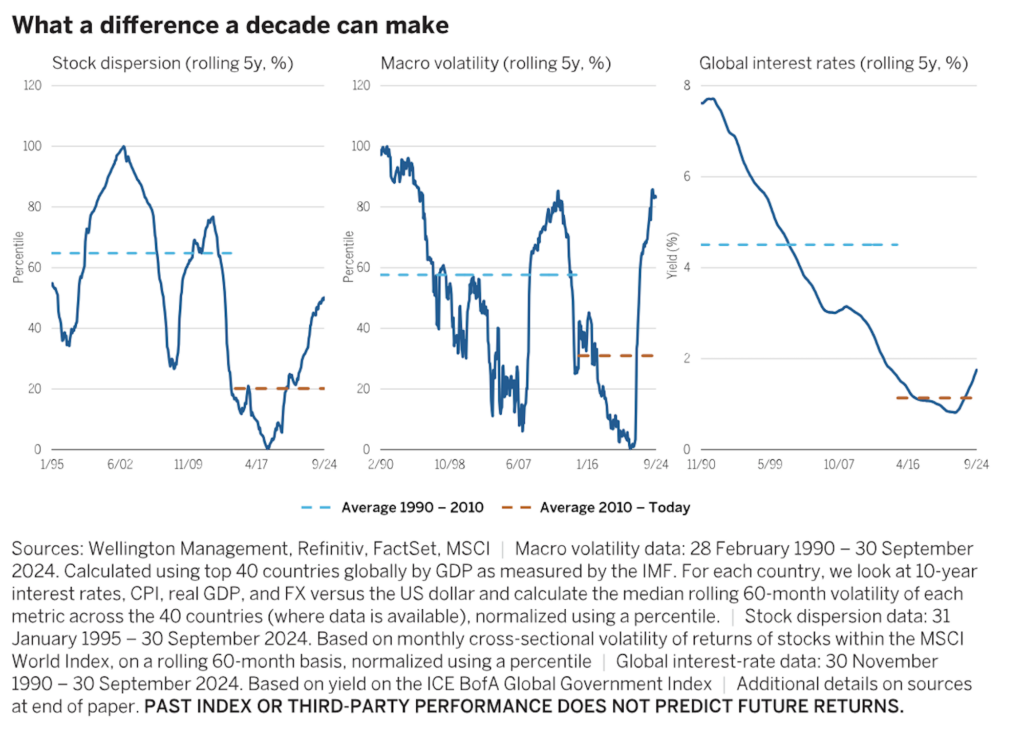
The 1990s and 2000s were strong periods for hedge fund performance, including equity long/short, macro, relative value, and event-driven strategies, while the 2010s were more challenging. Our research suggests that three market factors help explain hedge funds’ success in the earlier decades:
- Security dispersion, a measure of the degree to which the returns of individual securities (e.g., stocks or bonds) deviate from one another, was high. This provided hedge funds, such as equity long/short funds, with a rich hunting ground for alpha through security selection.
- Macro volatility, which captures fluctuations in macroeconomic variables (e.g., currencies, interest rates, and inflation), was elevated. This created a dynamic environment that was ideal for hedge funds that seek to exploit top-down economic events.
- Interest rates were meaningfully higher than today. Higher rates tend to coincide with higher volatility and dispersion, which may be favorable for hedge funds. Higher rates are also beneficial because hedge funds usually maintain substantial cash reserves to implement trades using derivatives and leverage.
Figure 1 shows the dramatic difference in these factors between the 1990s/2000s (blue dashed line) and the 2010s (orange dashed line). Importantly, it also shows that all three have been on the rise recently — a positive sign for hedge fund investors, in our view.
Figure 1
What’s fueling the change?
We believe we have moved from the relatively stable environment of the 2010s to an economic regime characterized by:
- Structurally higher inflation driven by a tighter labor market, higher fiscal spending, underinvestment in commodity production, and deglobalization
- A tricky monetary policy balancing act for central banks as they try to keep inflation in check while also supporting economic growth, resulting in more economic uncertainty and policy variations across regions
- More active government involvement in the economy via regulation and industrial policy
We expect all of this to spark higher levels of macro volatility and dispersion in economic outcomes at the country level, which, in turn, should drive more dispersion in the performance of individual securities (fluctuations in interest rates, inflation, and growth impact companies differently). In addition, structurally higher and more volatile inflation, combined with increased fiscal and industrial policy, should lead to higher interest rates.
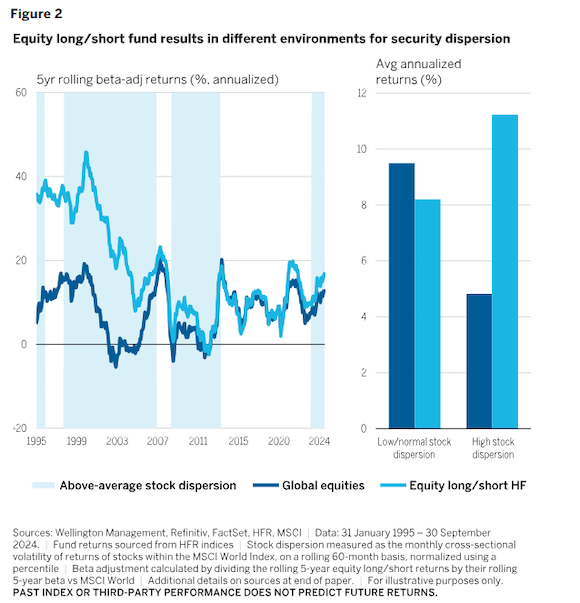
For a sense of how this could benefit hedge funds, Figure 2 looks at the performance of equity long/short funds depending on the level of security dispersion. The left chart shows the five-year rolling beta-adjusted outperformance of equity long/short funds relative to the global equity market. The funds generated strong outperformance during periods of above-average security dispersion (shaded in light blue). The right chart shows average annualized returns in periods of low/normal security dispersion and in periods of high security dispersion. It’s clear that long/short managers generated their outperformance in the latter.
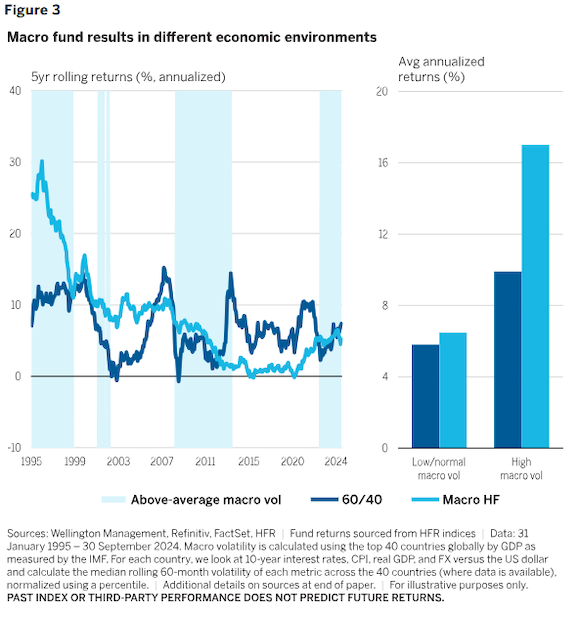
Similarly, Figure 3 looks at how macro hedge funds performed in different economic environments using the five-year rolling outperformance of macro funds versus a 60% equity/40% bond portfolio. We used the 60/40 portfolio rather than global equities because the former is more comparable to macro funds, which tend to take less risk than equity long/short funds and have a larger fixed income component. We did not beta adjust the returns given that macro funds tend not to carry a lot of equity beta.
The left chart shows that macro funds outperformed when macro volatility was above average (shaded in light blue). The relationship is clear, though marginally less strong than in the security dispersion analysis above. The right chart shows that macro funds generated much stronger average annualized returns than the market in periods of high macro volatility and were more in line with the market in periods of low or normal macro volatility.
Mapping the path forward
If our outlook is correct, hedge fund managers may find more ways to generate alpha and their clients should benefit. To prepare for this potential shift, we think investors should review the size and
composition of their hedge fund portfolios. Hedge fund exposure should be large enough to make a meaningful contribution to their objectives and to dampen total portfolio volatility in turbulent markets.
Finally, given the growth in the hedge fund industry (at about US$4.3 trillion, it is more than 110 times larger than in 19901), manager selection is likely to be more important to investment success and investors should review their approach. Read more on manager research and our hedge fund outlook in our recent paper, “Goldilocks” and the three drivers of hedge fund outperformance.
1 Source: Hedge Fund Research Inc., as of 30 June 2024.
 Alex King CFA, Investment Strategy Analyst – As an investment strategy analyst on our Multi Asset Platform within the Investment Strategy Group, Alex conducts and shares research on asset allocation, portfolio construction and structural investment problems. He advises clients, and undertakes data analysis, to build multi-asset solutions designed to meet their specific objectives.
 Adam Berger, CFA, Head of Multi-Asset Strategy – Adam leads Wellington’s team of multi-asset strategists globally. The team’s objective is to help our clients achieve better investment outcomes by providing them with relevant research, analysis, and advice. As a strategist, he focuses on US public pensions and other total-return-oriented investors. He develops research from an allocator’s perspective, advises clients and prospects on a range of investment policy and governance issues, and serves as the portfolio manager for bespoke multi-manager investment solutions, helping to bring iStrat’s team-based process to bear on a client’s specific objectives and constraints.