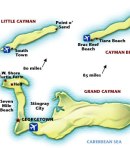
Offshore hedge fund jurisdiction Cayman Islands expects to register 1,200 new open-ended funds in 2010.
This is the same figure as in 2009, bringing the total the number of Cayman hedge funds back to the pre-crash level of 9,589.
While there have been speculations in the international mainstream press that Cayman is going to fail because the EU is going to rise, members of a recent Opalesque Cayman Roundtable claim Europe’s success does not have to mean Cayman’s failure, as the products and regulations are seen as complimentary.
If hedge fund managers explore or set up European offerings, it is
Offshore jurisdictions should join forces to lobby larger nations and international organisations on matters affecting them, according to members of the offshore financial services industry.
While there are obvious ways in which Jersey, Guernsey and the Cayman Islands are competitors, there are also issues of common interest, such as the European Union’s Directive on Alternative Investment Fund Managers and potential business synergies, according to speakers at a recent debate organised in Guernsey by international law firm Appleby that considered the relative strengths of the three jurisdictions as fund domiciles and service centres as well as possible avenues for co-operation.
A&L Goodbody remains the leading Irish legal adviser to the Irish funds industry, representing domiciled and non-domiciled funds with a combined asset value in excess of USD238bn, according to the Lipper Ireland Fund Encyclopaedia 2010/2011.
The Lipper report shows that the total combined size of the Irish funds industry at the end of June 2010 was in excess of USD1.1trn US dollars with 3,816 separate domiciled and non-domiciled funds being serviced in Ireland.
Brian McDermott, head of investment funds at A&L Goodbody, expects the industry to continue growing on the basis that Ireland remains a very attractive location for international
Maitland, a fund administrator, has reached USD100bn of assets under administration.
This follows a contract with South Africa’s largest multimanager, Investment Solutions, to administer its underlying investment manager portfolios.
Maitland operates internationally with South Africa as an offshore fund servicing location. The company has more than doubled assets under administration over the past three years and international fund managers now account for nearly half of its client base.
Chief operating officer Veit Schuhen believes that sustained market volatility together with an increasingly demanding regulatory environment will continue to favour third party administrators.
“The demand for transparency and demonstrably effective risk
Cantab Capital Partners, a UK-based alternative investment company, is preparing to launch the Cantab Quantitative Ucits Fund.
Cantab launched the offshore CCP Quantitative Fund in March 2007.
The CCP Quantitative Fund has had an annualised return of 13.3 per cent from inception to date and has shown very low correlation to both equities and the broad hedge fund universe.
Chief executive officer Ewan Kirk says: “Cantab’s alpha generation comes from a basket of sophisticated and robust statistical models which are risk managed using a state of the art framework implemented in an unparalleled technology infrastructure. We have a highly diversified
The US Commodity Futures Trading Commission has filed an enforcement action charging Phillip Milton of Palm Beach Gardens, Florida, Gregory Center of McLean, Virginia, William Center of Richmond, Virginia, and their company Trade, based in Palm Spring Gardens, Florida, with operating a Ponzi scheme involving approximately USD28m in connection with the Trade commodity pool.
On 22 June 2010, the same day the CFTC complaint was filed under seal in the US District Court for the Southern District of Florida, the court entered an order, also under seal, freezing defendants’ assets and preserving books and records. Both documents were unsealed by
Fund of hedge funds manager International Asset Management says it continues to favour the opportunity set for long/short equity managers focused on the Asian and emerging markets.
Morten Spenner, chief executive at International Asset Management, says there is a high likelihood of slow economic growth in the major developed countries.
This level of recovery is not sufficiently strong to bring forward monetary tightening but nor is it so weak that it will prevent reasonable earnings growth. Furthermore, loose monetary policy is allowing companies to borrow cheaply.
Faster growth is anticipated in emerging markets. Equity market valuations are reasonable, inefficiency is
GlobeOp Financial Services has completed a Type ll independent examination of its middle, back office and fund administration controls and Transaction Solutions, according to new international standards replacing Statement on Auditing Standards No.70 (SAS 70).
The Big Four auditing firm examination included all ten GlobeOp offices on three continents and evaluated the design and operating effectiveness of specified GlobeOp controls for the full year from 1 October 2009 to 30 September 2010.
The two new standards replacing SAS 70 are the International Standard on Assurance Engagements (ISAE) 3402 “Assurance reports on controls at a service organisation”, and the Statement
Global derivatives average daily trading volume totalled 7.5 million contracts in October 2010, up 6.2 per cent versus the prior year but down 2.9 per cent from September 2010, according to figures from NYSE Euronext.
The increase in global derivatives ADV versus prior year levels was driven by a 23.8 per cent increase in US equity options ADV, partially offset by an 8.4 per cent decrease in European derivatives ADV.
Cash equities ADV in October 2010 were down year-over-year, but both European and US cash trading volumes increased from September 2010 levels by 3.0 per cent and 3.8 per cent,
The US Commodity Futures Trading Commission has filed an action in federal court in Austin, Texas, charging Richard D. Theye and his company Micind Capital Management with fraud in connection with running a multi-million dollar Ponzi scheme.
On 17 June 2010, the CFTC also filed a motion for a statutory restraining order to freeze the defendants’ assets and prohibit the destruction of books and records.
The SRO motion also requests that the court order the defendants to make a full accounting of all funds received by and paid to investors. The court scheduled a hearing on the CFTC’s motion for