Celebrated for its prestige, glamour, and exclusivity, fine wine represents a significant and intriguing opportunity for the medium to long term investor.
In November 2013 a case of 1978 Romanée-Conti was sold at auction in Hong Kong for $476,280, making those twelve bottles of Burgundy the most expensive case of wine ever sold. This was an exceptional event that made the news worldwide, a dramatic illustration of how the romance, heritage, and glamour attached to the great names of the wine world helps transform them into Veblen goods, whose high price increases rather than diminishes their desirability. Although spectacular, the price was not pure caprice: the criteria that determine value in wine are well-established and objectively assessed against documented and long-term historical data. Experts were unanimous in confirming the sublime quality of the wine, in a market where purchasing power determines value.
Long recognised as an investment vehicle, fine wines exhibit a near-perfect inverse supply curve. Production of wines from the top estates is limited, often extremely so. More significantly, while the amount of wine in circulation diminishes over time its intrinsic value increases as the wine matures, typically from 10 to 40 years after the vintage. Other traded commodities – art, for example – depend on subjective opinion (or more often fashion) to increase in value. Fine wine, in the simplest possible terms, objectively gets better as it gets older. As it gets both better and rarer, it naturally increases in desirability and value.
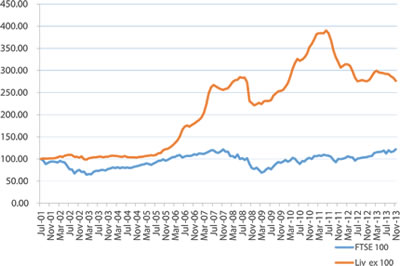
The result is reliable appreciation. During the past ten years, the average compound annual growth rate (CAGR) generated by the worst-performing of 200 wines from 24 of the top Bordeaux châteaux was 5.4%, a clear 2.6% over the long term rate of inflation in the UK. Reassuring, if unspectacular, but the potential upside is rather more exciting: a best-in-class average CAGR of 18.4% pa, with an overall average for all 200 of 12.9% pa. In real terms, that means for £10,000 invested the minimum return after 10 years was £16,920, the average £33,646, and the maximum £54,140. These rewards are to a large measure protected against short-term economic fluctuations, with a standard deviation of just 3.7% over the period since 1988. Investors over a mid-to-long-term period are therefore entitled to feel confident that their capital will not experience any major value swings.
Traditionally, trading has focussed on the great names of France, the wines of Bordeaux, Burgundy, and Champagne. In recent decades, the Super Tuscans – wines originally produced in defiance of the then-shambolic DOC system, now the flag-bearers for Italian quality – have joined this glamorous elite. These represent classic ‘safe bets’, with solid and largely predictable appreciation over time. Holdings in Burgundy’s Domaine Romanée-Conti or Tuscany’s Sassicaia are certain to gain steadily over time, and offer the greatest ownership cachet, but as with all sectors the most secure investments will not necessarily offer the best value.
Below is a table of all the Bordeaux wines from the 2009 vintage that were awarded 100 points by the benchmark Robert Parker scores and which also have at least one perfectly-scored back vintage for price comparison.
| wine | price 2009 | price back vintage | difference |
|---|---|---|---|
| Haut Brion | £6,500 | £11,200 (1989) | +72% |
| Latour | £10,500 | £18,500 (1982) | +85% |
| Mission Haut Brion | £5,200 | £9,500 (1982) | +83% |
| Petrus | £27,500 | £33,500 (1990) | +22% |
| Clinet | £2,300 | £5,400 (1989) | +135% |
| Beausejour Duffau | £3,000 | £7,200 (1990) | +140% |
| Montrose | £2,350 | £5,500 (1990) | +134% |
| Pavie | £2,750 | £4,550 (2000) | +65% |
| Le Pin | £27,500 | £85,000 (1982) | +209% |
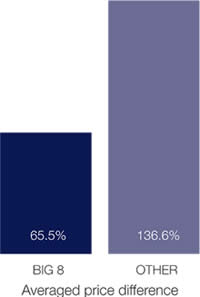
unearthing value
Big 8 compared with other Bordeaux wines using the 100-rated vintages for comparison
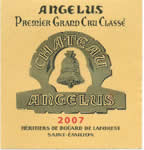
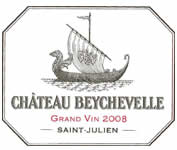
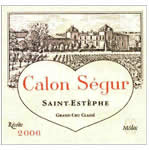
Clearly, there is room for considerable price movement from the top-rated wines outside the Big 8. The same principle applies as truly great wines continue to emerge or be uncovered from other regions and countries such as California, Spain and Australia. And, as in all markets, intangibles and events make their mark and interfere with projections. The rise of China as a leading player in fine wine trading exemplified by the purchase with which this article began has transformed the market in ways that have been, and continue to be, hard to predict. While purchasing trends have matured, moving from emphasis on ‘brands’ back towards the more traditional method of considering the overall regional vintage quality, then the Parker score, before the name, unforeseen factors such as vagaries of labelling that coincide with Chinese culture have played a major part in boosting the fortunes of some wines over others. Château Beychevelle has a ‘dragon boat’ on its label; Angelus (as one might expect) a golden bell; Calon Ségur a heart: all have by pure coincidence increased the desirability of these indisputably fine wines over others of comparable quality. Thus the news that a Chinese artist had been selected by Mouton-Rothschild for the label of its 2008 vintage was met with a profound lack of surprise in the wine trade.
Founded in 2007, Cult Wines are relative newcomers to the market but have already laid claim to Premier Cru status for service and expertise (check out their TrustPilot reviews for objective and enthusiastic endorsement). This isn’t the vinous arm of a larger investment house: CW are specialists who only deal in fine wine investment and have taken advantage of their recent arrival to provide customers with state of the art online portfolio tracking, with a dedicated manager who will create a portfolio diversified to reflect your individual risk and term specifications.
Supply is of course critical to the offer. Not only do CW have an extensive network of agents throughout the world who ensure the best possible access to sought-after vintages, their interest as investment managers – unlike that of your wine merchant – matches yours in doing so at the lowest possible price. Their fees are refreshingly simple and transparently inclusive, research and reporting is regular, in-depth and clearly summarised, and the staff are enthusiastic, personable and putting a fresh twist on what can be a somewhat stuffy trade. There are, of course, plenty of people ready to take your shilling in order to manage your wine investments. We merely suggest that, if fine wines are an option that interests you, it may well be in your best interests to talk to Cult Wines before making any decision.