PARTNER CONTENT
By Christopher Perret, CFA, CAIA, Investment Director, Wellington Management
The views expressed are those of the authors at the time of writing. Other teams may hold different views and make different investment decisions. The value of your investment may become worth more or less than at the time of original investment. While any third-party data used is considered reliable, its accuracy is not guaranteed. For professional, institutional, or accredited investors only.
In recent months, financial markets have faced significant turbulence. Relatively risky assets, particularly equities, have experienced double-digit declines. The S&P 500 Index, a proxy for US equities, is down more than 15% from its February 2025 highs, and many companies have seen even more substantial declines in valuations. This downturn has been accompanied by concerns about a growth rerating (lower), which has dealt a blow to market breadth – with many equity indices falling below their 200-day moving averages and recording lower lows in six out of the past seven weeks at the time of writing.1
What’s causing this?
Doubts about markets’ ability to hit growth expectations appears to be the force behind this bout of market volatility. This comes at a time when, in some cases, certain assets appeared to have been “priced to perfection.” At the same time, other warning signs, such as weakening consumer data (e.g., credit card delinquencies) and decelerating earnings revisions, have been emerging. Additionally, the frenetic pace of new policies and actions taken by the new US administration, including “reciprocal” tariffs, questions over spending cuts and US deficit expansion, and immigration policies, could have added to investors’ anxiety.
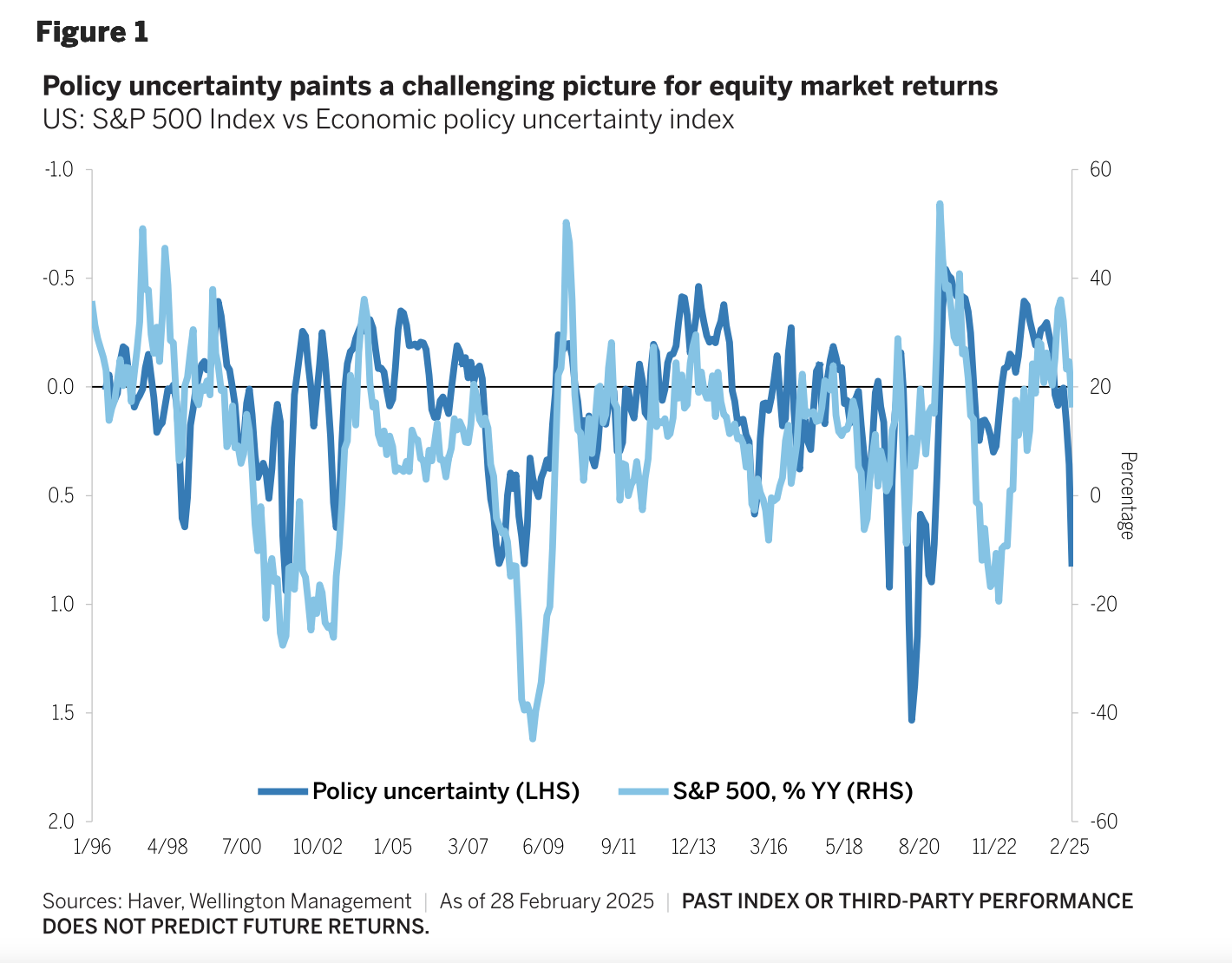
Sticky inflation is also a prevailing market concern. The US Federal Reserve (Fed) and other central banks have indicated that they will have to contend with inflation despite growth risks. What’s more, geopolitical tensions around the world, including wars, elevated tensions in the Pacific, and rhetoric from the US administration about increasing its strategic presence in the Arctic, further exacerbate the situation. The combination of these factors elevates economic uncertainty. Were this to persist, risky assets may come under even further pressure (Figure 1).
And what will happen next?
The current market correction has raised several questions with short- and longer-term implications. Right now, investors may be asking: Is the correction over? But the current state of the markets prompts broader, longer-term questions, too. Will the US continue its exceptionalism and growth leadership among other major economies? Will the Fed and other central banks focus future policy actions primarily on growth (weakness) or inflation (stickiness)? Will investors begin to derisk in the face of recessionary fears?
The answers to these questions are mixed, but one thing is certain: Numerous structural forces, such as deglobalization, suggest that economic cycles will oscillate much more quickly through the growth and inflation quadrants, experience higher highs and lower lows, and push markets to extremes in some cases.
What we’re hearing from investors
This correction reminds investors to revisit their capital market expectations and assess whether their current mix of asset allocations can conceivably achieve their objectives given still-elevated valuations and the factors driving uncertainty we explored above. One main conclusion from this may be that many portfolios could benefit from alternative sources of return and diversification. Specifically, diversifying hedge fund strategies have been a major topic of interest in recent discussions.
Importantly, we see strong economic reasons why many investors are either adding or considering adding diversifying strategies, such as hedge funds, to their existing portfolios. Conditions for delivering consistent, uncorrelated, alpha-centric returns have markedly improved while beta-centric returns, especially when adjusted for risk, are in decline. Elevated dispersion and macroeconomic volatility have contributed to these dynamics.
Diversifying your diversifiers
When equity markets fell in 2022, many investors realized bonds aren’t always an effective recessionary hedge especially in the face of rising and sticky inflation. Thus, finding strategies immune to duration risk that can still deliver the intended diversification benefits can be quite useful. Certain hedge fund strategies may fill this role and expand portfolio diversification effectively. This isn’t to say that fixed income shouldn’t feature in a portfolio. It should, but we believe that given the return potential, investors may do well to find options to complement or diversify traditional fixed income.
Key to this is identifying what matters most across these two dimensions — offsetting potentially lower returns or adding protection at the (marginal) expense of some return. Regardless of where investors fall on the return/diversification continuum, we believe diversified, uncorrelated strategies, including multi-strategy and global macro, may be well-positioned to provide tangible benefits and should, in many cases, be a mainstay in investor portfolios, especially in this highly uncertain and turbulent environment we seem to have entered.
1April 7, 2025
 Christopher S Perret, CFA, CAIA, Managing Director and Investment Director – Chris is the diversifying strategies platform leader within Hedge Fund Investor Relations. Investor Relations is responsible for the product management, risk oversight, distribution and client servicing of certain Wellington-managed fund vehicles that pursue alternative investment strategies. In his role he is primarily responsible for the execution of the business strategy within our diversifying strategies platform, consisting of Wellington’s multi-strategy, macro and credit hedge funds. Prior to joining Wellington Management in 2010, Chris worked at State Street Global Advisors (2008 – 2010), where he contributed to the product management of the firm’s fixed income approaches. Before that, he held positions in FX and equity trading for State Street Corporation (2004 – 2008). Chris earned his MBA, with honors, from Boston University (Questrom School of Business, 2010) and a BBA in finance from the University of Miami (2004). Additionally, he holds the Chartered Financial Analyst and Chartered Alternative Investment Analyst designations and is a member of the CFA Institute and the CFA Society Boston.